
🦪 Recipe for a Fond Memory

This recipe story is an excerpt from the Tidewater Oyster Gardeners Association Spring 2025 Newsletter. Sadly, the author Howard Delano passed away February 15 of this year. TOGA reprinted this “particularly poignant” essay of his from the Fall 2023 newsletter, writing “We will miss our friend Howard.” You can read the full newsletter here.
As a small boy, I enjoyed oysters every winter. I remember oyster stews on weekends that cheered the cold gray days of winter. When I was a teenager, my mother would open the stairway door and shout “your oysters are getting cold.” I would hurriedly jump from my warm bed and rush downstairs to find that they hadn’t even made it to the sauce-pan yet. I knew enough then not to protest the cook.
I would remember when I stood as a small child, barely taller than the table, as I watched my father shuck oysters on the back porch. When he opened a shell and a perfect beauty of an oyster was discovered, he would say “Boy, this oyster is too pretty to put in the bowl with those other oysters.”

I would open wide and enjoy the delight of another fresh raw oyster. That was 80-some years ago, and I cherish that childhood memory.
I never got many chances to attend enough oyster roasts as a boy, but they are still in my memory. The oyster roasts in the 1930s and 1940s were outdoor events, and the men did the cooking. The weather was often not the best, and you needed strong young men, shelter for tables, and a location suited to have a fire. Brawn, and not the talents of a chef, is better suited here.
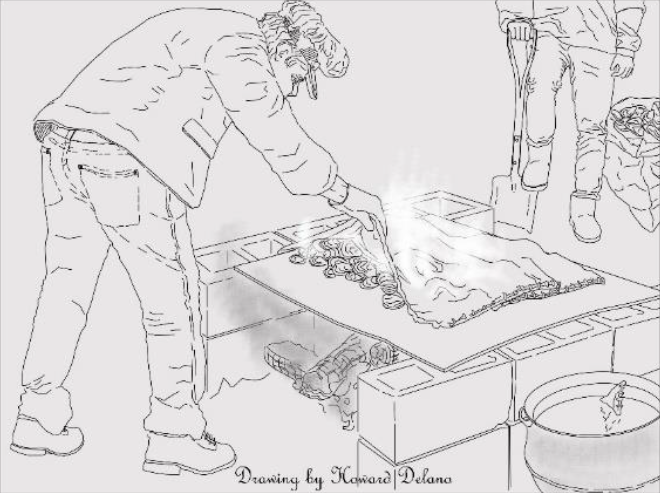
Two low walls about 16 inches high would have to be built from flat sandstone or cinder blocks and located about three feet or a little more apart to contain the fire. A heavy gauge steel plate, approximately 36 inches by 48 inches, would have to be made ready to pull onto the walls over the hot coals.
On the day of the oyster roast, a fire would be made between the knee walls using available split hardwood logs. When a good bed of coals was produced, two young men would pull the steel “boiler-plate” up and onto the knee walls and over the hot coals. As the plate was heating, a pot of cold water was situated near the fire to soak a couple of burlap bags.
When the plate was hot enough to make a drop of water dance, half of the oysters from the bushel of oysters were dumped from its burlap bag onto the steel plate. It is much better here to use a shovel to thin the oysters to a single layer to allow for uniform cooking. One or two water-soaked burlap bags would then be layered on top of the oysters, being sure that all of the oysters are covered.
After eight minutes, using a rubber-gloved hand, I would peek under the burlap blanket to see if one or two of the oysters had opened. A customary cry of “are they ready yet?” to which an answer of “almost” is the most frequently heard. When one or more oysters open, quickly remove the burlap and shovel the oysters into two one-peck buckets and hurry to the waiting crowd at the tables. Repeat as necessary. The re-cycling of dripping water onto a hot plate to steam and re-condense on the wet burlap to be dripped again to hot plate to re-steam makes this method one that has endured over 100 years.
Cover photo drawing by Howard Delano



What a delightful story! You really get the feeling of his love of oysters!