
💡 Breeding Better Oysters

If you’ve ever wondered what it takes to breed oysters, Hannah Colwell is the right person to ask. As a hatchery technician at the Northeast Oyster Breeding Center, Hannah is part of a small but mighty team responsible for raising oysters from broodstock to seed. She’s also the winner of our AIE Award for Excellence in Research! In this post, Hannah takes us through the oyster breeding season, shares what it’s like to work with the Cawthron Ultra Density Larval System (CUDLS), and reflects on what makes the Milford Lab such an important cornerstone of shellfish aquaculture. Enjoy!
AIE: What initially drew you to hatchery work, and how did you get involved with the Northeast Oyster Breeding Center?
Hannah: My background is actually primarily in vertebrates, including an aquatic frog research facility and the Woods Hole Science Aquarium, where I cared for everything from harbor seals to jellyfish, but never shellfish. I was working in Woods Hole for several years, but had wanted to move closer to family in Connecticut. My dad worked in Milford and had been talking about the Milford NOAA NEFSC Lab since I’d expressed interest in marine biology in high school, so I was excited to see a position available at the lab, particularly since I’d had a great experience working with the NEFSC while at the aquarium. Since I had not worked with shellfish before, I saw it as an excellent opportunity to learn a new branch of marine animal care.
AIE: Can you walk us through what a typical day looks like for you at work?
Hannah: Something that sets this job apart from other jobs in my past is how dynamic it is. Every job in animal care comes with the sense of not always knowing what your day will bring, but most daily tasks remain the same. Hatchery work is seasonal and with every stage of early oyster life comes a new system and a new schedule. Our project only has one or two spawns in early spring, so daily tasks can change month to month, if not more frequently.
In September, in the “off season”, my fellow technicians and I can be found analyzing data collected over the prior season, discussing different ways to improve procedures and updating SOPs, researching to get a better understanding of the animals we are working with, assisting in construction of systems and materials needed for the next season, and sometimes running experiments to test theories on how to better grow our oysters. January brings our broodstock, which must be kept quarantined as they come in from different states to protect Connecticut waters. They require water changes three times a week, daily water quality monitoring, treatment of “dirty” water, and gonad checks as weeks of conditioning go on. March and April hold the most intense weeks and kick off our real busy season.
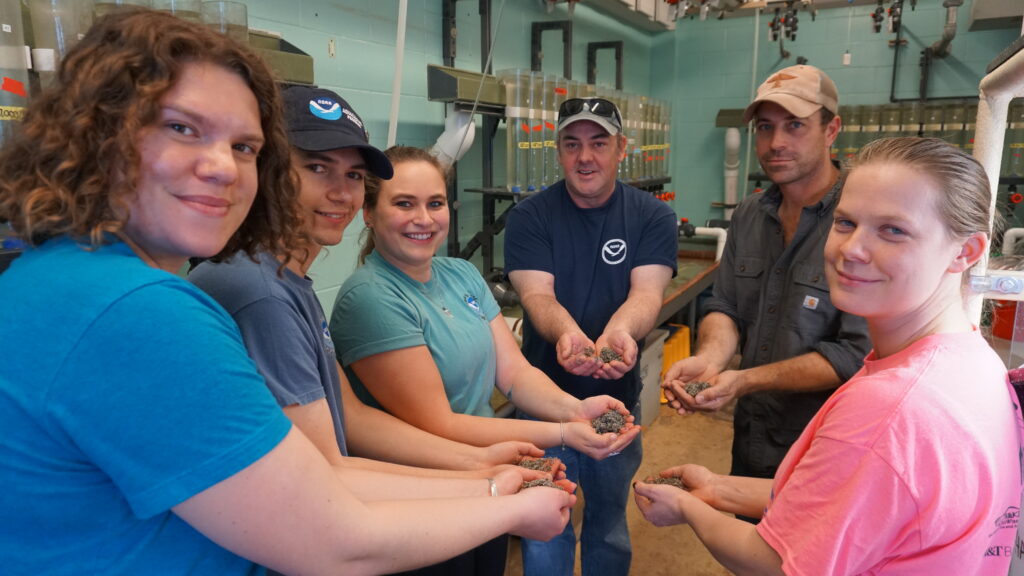
We spend one day scrubbing all ~400 broodstock, the next shucking and sexing them, and then finally our strip spawn, where sperm and eggs are “surgically” released by cross hatching the gonad with a scalpel. Family crosses are then created with assistance from our colleagues at the USDA. After 30 hours, the larvae are moved into our larval system, the CUDLS (Cawthron Ultra Density Larval System), a system designed by the Cawthron Institute. It is a flow through system lined with 2.5 L individual bottles that can hold up to 500,000 eyed larvae. The saber screens in each bottle are cleaned daily to prevent overflows and each family is screened, assessed, and counted every three days, increasing to every two as they near setting.
The CUDLS is the most labor intensive and can last up to 21 days. A steady stream of small bubbles is used to keep the screens clear of algae and waste products and must be positioned precisely so as to work properly. This and other parameters such as flow, temperature, and pH are monitored carefully during these delicate early stages. When they are ready to set, they are moved to our recirculating downweller system, where besides daily water quality checks and partial water changes, they are left alone to go through their metamorphosis.
Finally, they are moved to our recirculating bottle upwellers for about five weeks. There are daily water changes, water quality checks, and the seed is screened down once a week for assessment and counts. During any downtime throughout the season, we keep our digital records up to date. Once they reach 5mm in mid to late June, they are given one final count and sent to our USDA ARS colleagues to be distributed to partner farmers who will grow them out for future genetic testing and family performance evaluation by the ARS. We shut down and clean our systems, take a deep breath, and restart the cycle.
AIE: What’s something you’ve learned at the Center that surprised you?
Hannah: Something I wasn’t aware of before arriving at the Milford Lab was how influential the lab has been in oyster aquaculture. Victor Loosanoff, the first director of the Milford Lab, developed the Milford Method, which is widely used in shellfish rearing. His 1963 paper “Rearing of Bivalve Mollusks” is referenced in literature to this day. The lab also houses an extensive microalgal culture collection that many facilities order starter cultures from. I was surprised a facility not far from my childhood home was such a cornerstone in shellfish aquaculture.
AIE: What has been the most exciting or rewarding part of your work?
Hannah: The most rewarding part of the job is seeing the oysters, particularly the post set. One of my primary roles is screening the oysters down during their various life stages and there’s something special about pouring one of our bottle upwellers over a screen, rinsing away the microcultch, and seeing the pile of seed left behind. They are the living result of months of planning and hard work, proof that all of it was worth it.
AIE: What do you hope your research will lead to in terms of oyster restoration or aquaculture industry improvements in the Northeast?
Hannah: The overarching goal of our project is to make successful oyster growing more accessible in a wider range of locations in the Northeast. Right now we are laying the groundwork to start building genetic families that might be resistant to various diseases, heartier in cold temperatures, or thrive in areas of high salinity. That way, if someone wants to start a farm in waters that traditionally would be difficult to grow oysters, a recommendation can be made about which strain they should use to overcome those difficulties.

Responses