
Building an Exciting Career in Coastal Resilience: A VASG Fellow’s Journey

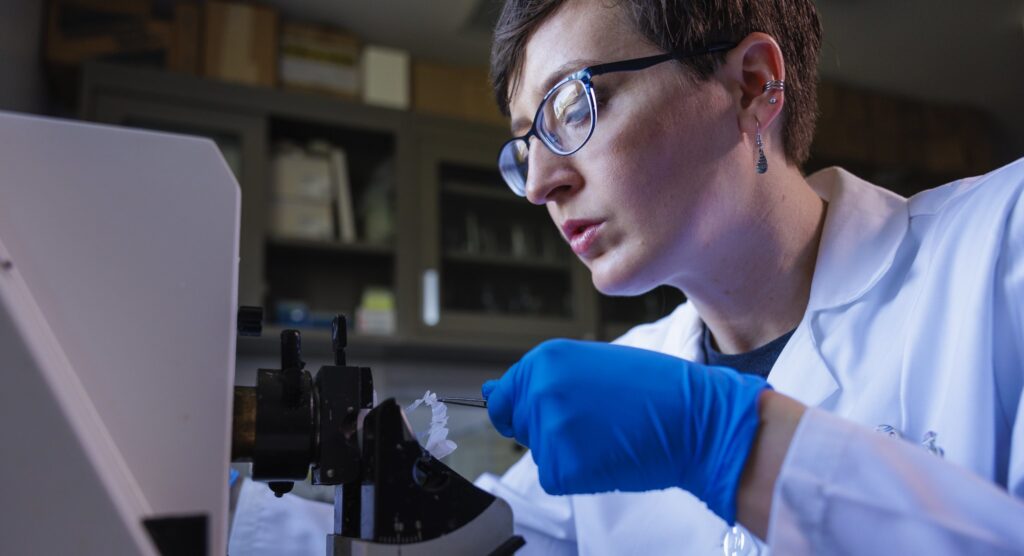
This post is an excerpt of the Sept. 18, 2024 Virginia Sea Grant article on the career of Lydia Bienlien, written by Joe Caterine with photos and video by Lathan Goumas. You can read the full story here.
Lydia Bienlien: Connecticut State Shellfish Pathologist
A VASG Fellow’s journey to an impactful career in marine science and policy
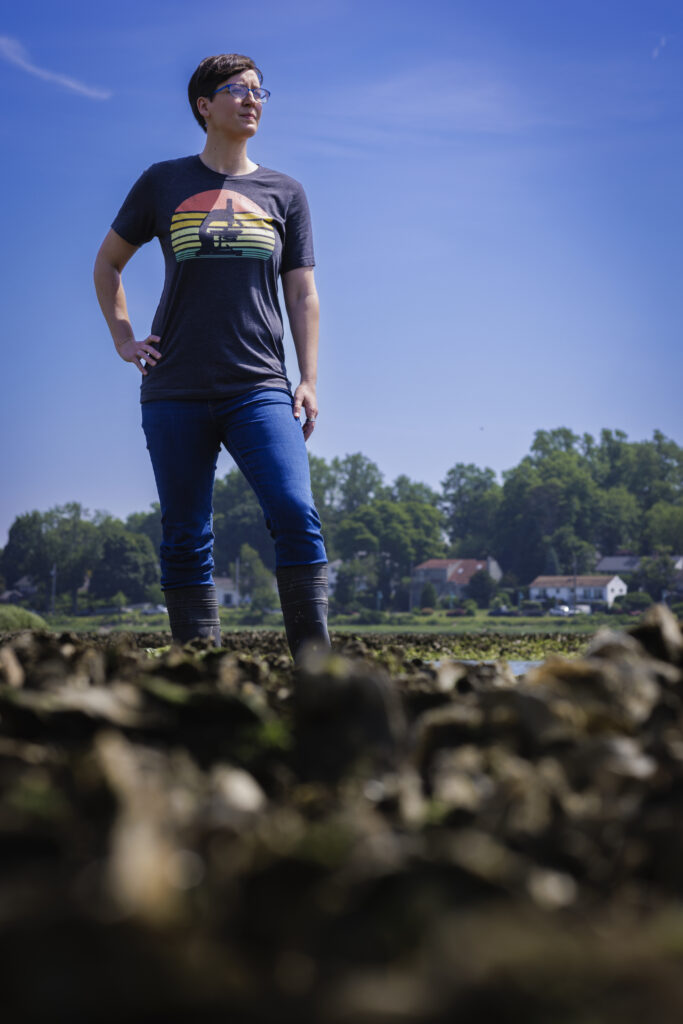
When Lydia Bienlien reflects on her time as a Virginia Sea Grant fellow, she sees it as a pivotal opportunity that paved the way to her current role as the state bivalve shellfish pathologist at the Connecticut Department of Agriculture’s Bureau of Aquaculture and Laboratory Services. As the Coastal Adaptation and Protection Fellow, she worked for the Virginia Department of Conservation and Recreation, where she became familiar with the intersection of policy and science that has come to define her career.
“Coastal resilience work is a complex problem that requires experts from different areas, walks of life, and experiences to come together over a significant period of time,” Bienlien said. “For students who want to move into that space, Virginia Sea Grant and its fellowships are positioned perfectly to allow students the flexibility needed to see which aspects of resiliency work they’re most interested in.”
Discovering Aquatic Health and Working in State Government
As an undergrad at Morningside College, Bienlien first considered pursuing an occupation in human health, but an internship at the Virginia Institute of Marine Science (VIMS) introduced her to aquatic animal health, including oyster disease which became the focus of her studies.
“It was more the disease parasite dynamics that I was interested in,” Bienlien said.
She would go on to earn her master’s and Ph.D. at VIMS, where she learned about Virginia Sea Grant and its fellowship programs. Even with her scholastic achievements, Bienlien knew that she wanted to go beyond academia. The Coastal Adaptation and Protection Fellowship seemed like the perfect fit.
“I wanted to go into federal state service, which is one of the things that attracted me to doing the fellowship in the first place,” Bienlien said.
This fellowship was designed to support the Virginia Coastal Resilience Master Plan, a state strategy aimed at addressing the challenges of sea level rise and increased flooding in coastal Virginia. In that role, Bienlien drafted a guidance document about strategic relocation for coastal communities, referencing case studies from across the United States.
“[Strategic relocation has] been done in other states like Louisiana, but there isn’t a clear mechanism how localities like cities and counties in Coastal Virginia could use that as a strategy,” Bienlien said in a previous interview with Virginia Sea Grant. “It’s more of a long-term approach, so it requires a lot of planning and thought.”
During this time, Bienlien learned to adapt to the fast-paced world of state government. “Priorities are different, timelines are different, and how the money works and who the power players are—that’s all different,” she said.
These dynamics became even more complex when Virginia switched governors in 2022, and Bienlien moved to working with the Department of Conservation and Recreation.
“It was interesting to see an administrative change,” she said, “and the importance of institutional knowledge and what a loss it is when some key players move on.”
Returning to Shellfish Pathology and Making Science Accessible
Thanks to the flexibility of her fellowship, Bienlien had time to find the opening for a shellfish pathologist at the Connecticut Department of Agriculture, a position that aligned more closely with her academic expertise.
“My boss at the time was fantastic, seeing that I needed to make a next step and providing advice about moving forward,” Bienlien said. “I appreciated that forward thinking for a fellow in my position.”
After starting her new job, Bienlien faced a learning curve. She had expected to focus mainly on shellfish pathology but found herself having to balance her laboratory responsibilities with her regulatory duties. Fortunately, the Virginia Sea Grant fellowship made this transition easier.

Responses