
Aquaculture and Climate Change

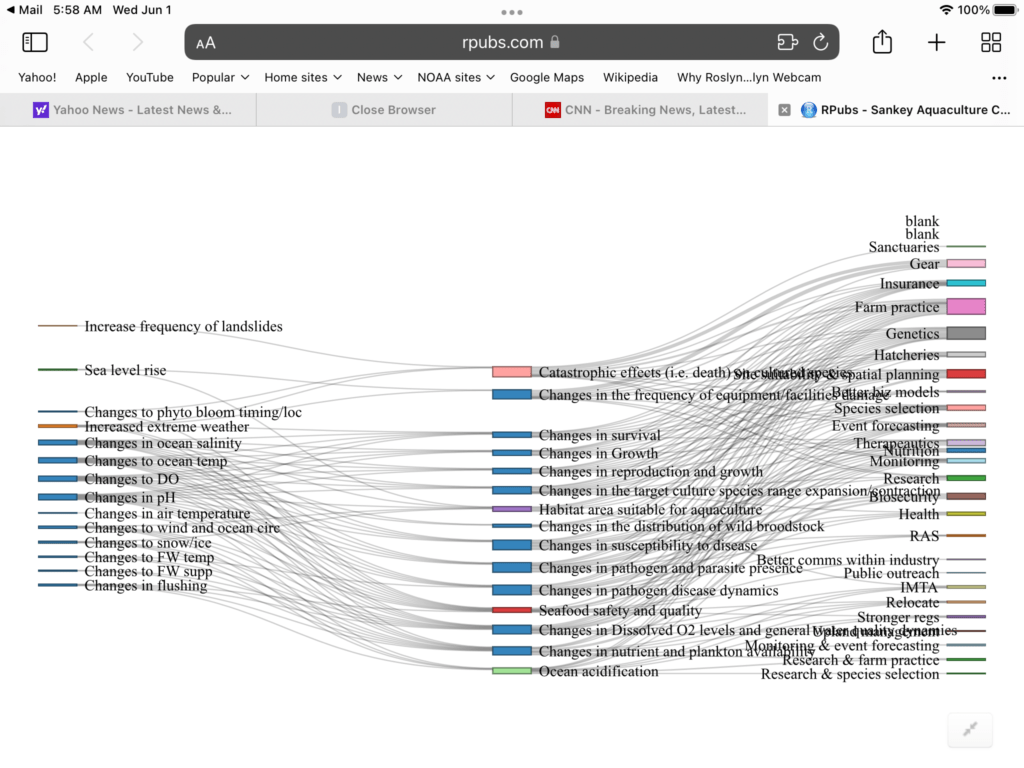
According to the world economic forum’s 2023 Global Risks Report, the failure to mitigate and adapt to climate change are the top two risks to the worlds economies in the next 10 years. Do you want to help make a smooth transition to a climate smart aquaculture so we can avoid these risks for our sector? The first step is to join us at a special session of the Effects of Climate Change on Our Worlds Oceans – 5 conference, online or in Bergen Norway this April! We are going to be asking you for your thoughts on climate driven risks and opportunities and how the world community might adjust. Details of the special workshop are below:
Building Collaborations to Identify and Address Knowledge and Technology Gaps with the Goal of Promoting Resilient Aquaculture in the Face of Climate Change.
Michael Rust, Hubbs Seaworld Research Institute, San Diego, USA
Clifford Cosgrove, and Dan Wiecorek NOAA Fisheries, Silver Spring, USA
Satoshi Watanabe, Fisheries Research and Education Agency, Mie, Japan
Ann-Lisbeth Agnalt, Institute of Marine Research, Bergen Norway
Climate impacts to seafood supplies will be felt at different degrees based on geographic location. Nevertheless, there are common but currently not agreed upon strategies that need to be developed to ensure resilient seafood from aquaculture. In addition, there are gaps in knowledge which need to be addressed before aquaculture is fully realized with respect to promoting global food security. This session will aim to begin to identify those gaps and begin the process of an ordered transition to climate resiliency. This workshop is designed to: 1) make connections among researchers, 2) to begin to identify the most likely and impactful changes driven by climate on aquaculture, and 3) to explore options for systematic analysis and reporting so that the scientific communities are focused and organized. Our working model would be to organize aquaculture experts to eventually develop a report(s) analogous to the annual risk survey put out by the World Economic Forum but with an aquaculture/climate focus. In addition to risks, we will include how aquaculture may present opportunities to adapt and potentially mitigate the effects of climate change.
The session will begin with a plenary presentation to set the context, outline the progress to date, and highlight the interactive workshops to follow. The workshop will use online tools to ask for attendee input over three 45-minute sessions and will add to similar data collected at other workshops (ICES Workshop on pathways to climate-aware advice, NOAA lead Climate Conversations with the US aquaculture industry). Data collected from the first workshop session will be an articulation by the attendees of the most important risks and opportunities presented by climate change to aquaculture produced seafood. The second workshop session will explore an organizational structure (working groups) and include commitments from members of the scientific community who wish to continue working on this issue. The final workshop will outline a suggested reporting format and include suggestions for moving forward.
Plenary Speaker: (30 minutes) Building Collaborations to Identify and Address Knowledge and Technology Gaps with the Goal of Promoting Resilient Aquaculture in the Face of Climate Change.
Workshop Session One: (45 minutes) Aquaculture and Climate Change Conversations
Focused on identifying risks and opportunities, resilience and mitigation.
Workshop Session Two: (45 minutes) Organization of the world scientific community.
Workshop Session Three: (45 minutes) Suggest types of reports, periodicity, and structure.



Hi
Today joined AIE and found the forum highly effective towards asserted objectives. May keep growing global aquaculture redressing future challenges.